
Qualifications
2008 – Began apprenticeship under master togishi Sasaki Takushi.
2009 – Polished several hoko by Amata Akitsugu for dedication to Ise Jingu.
2010 – Gave a polishing demonstration at the Oiso Municipal Museum in Kanagawa as part of the exhibition for Nagayama Koukan.
2010 – Gave a polishing demonstration at the Okura Museum in Tokyo as part of the exhibition for the annual NBSK sword craftsmen competition.
2011 – Gave a lecture at the Sydney Shinsa & Taikai.
2013 – Awarded gold prize in the annual NBSK sword polishing competition.
2008-2014 – Maintained the sword collection of the Kasama Inari shrine in Ibaraki.
2014 – Received my finishing papers from sensei, marking the completion of my apprenticeship.
2014 – Built my first workshop in Melbourne, Australia.
2017 – Polished a katana by Go Yoshihiro, which has since passed tokubetsu juyo token.
2023 – Founded the Touken-Togishi Kantei-Kai, the first of its kind in Australia.
2023 – Built my second workshop in Ballarat, Australia.
2024 – Polished a second katana by Go Yoshihiro.
2025 – Named as the new Secretary for the Gōshū Nihon Bijutsu Tōken Hozon Kai.
2008-Now – During my time as a togishi I’ve been fortunate to work on many masterpieces, including swords by Rai Kunitoshi, Awataguchi Kuniyoshi, Ko-Hoki Sadatsuna, and two by Go Yoshihiro.
Gold Prize (Kinsho)
Since the day I started my training, one of my goals was to win a prize in the annual sword polishing competition. The competitions are considered a way of ranking the craftsmen associated with Nihonto, it’s a great honour to win a prize and have your work exhibited in a famous Tokyo museum.
In 2013, sensei gave me permission to enter the competition for the first time and I managed to take a gold prize. It was an incredible feeling to receive this award and be recognised by the top craftsmen in my field.


Finishing Papers (Shuryosho)
Receiving these papers from sensei meant that my apprenticeship was complete. I was allowed to go independent and return to Australia, where I could open my own workshop.
The papers are for a period of 5 years – from the day I got my cultural visa to the day sensei declared I was ready to go independent. But actually my training commenced before this period and continued after, in total it lasted well over 6 years.
The calligraphy was done by one of Japan’s top traditional painters and the paper was handmade by a living national treasure of Japan.
Whenever I look at these papers I feel humbled thinking about the great people who helped me along the way, which inspires me to continue improving my work.
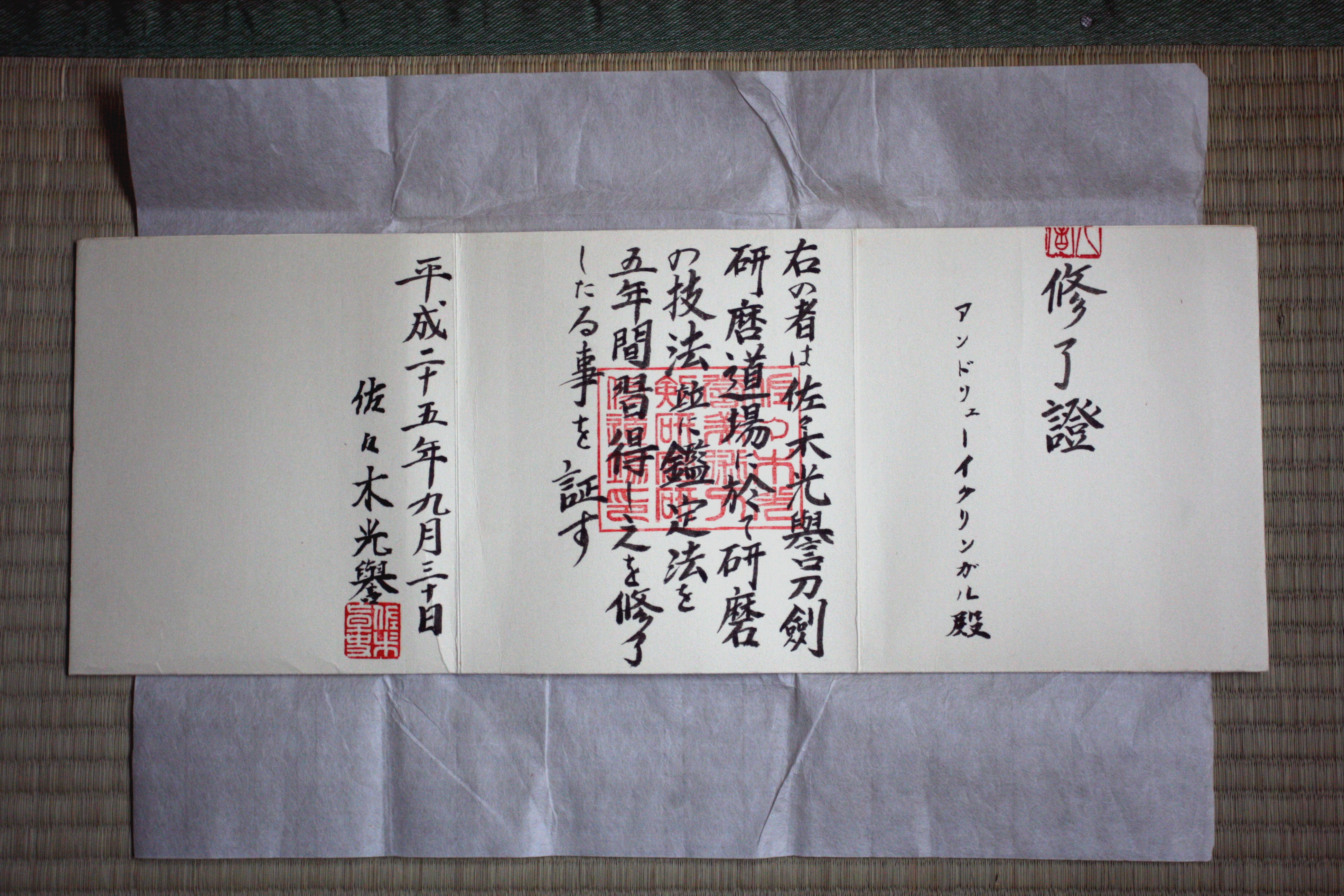
My finishing papers.
It reads:
修了證 – shuryosho – Completion certificate.
アンドリューイクリンガル殿 – Andoryu Ikuringaru dono – Mr. Andrew Ickeringill.
右の者は佐々木光譽刀剣研磨道場に – migi no mono ha, Sasaki Kouyo touken kenma doujou ni – The person written to the right of this is a part of the Sasaki Kouyo Japanese art sword polish and judgment dojo.
於て研磨の技法竝に鑑定法を五年間習得し – oite, kenma no gihou narabi ni kanteihou o gonenkan shutoku shi – Regarding the polish technique & judgment technique, five years were spent learning.
之を修了したる事を證す – kore o shuryou shitaru koto o shou su – This certificate proves completion of apprenticeship.
佐々木光
譽美術刀
剣研磨研
修道場印
Sasaki Kouyo bijutsu touken kenma kenshu doujou in – Sasaki Kouyo Japanese art sword polish and judgment dojo stamp.
平成二十五年九月三十日 – heisei 25nen 9gatsu 30nichi – 30/9/2013.
佐々木光譽 (印) (佐々木卓史) – Sasaki Kouyo (Sasaki Takushi seal).
 Andrew Ickeringill - Touken Togishi - 刀剣研師